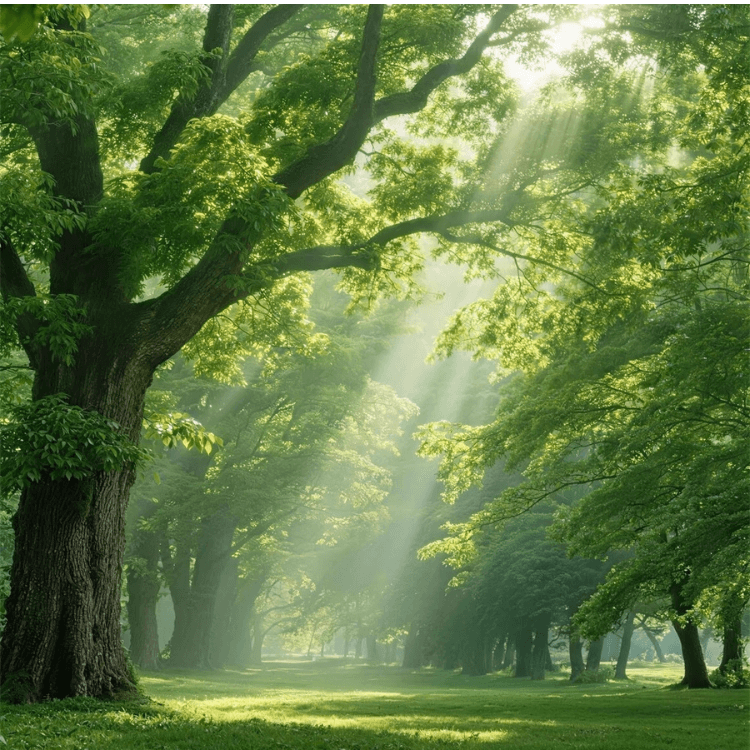
In contemporary wellness conversations, people frequently reduce the Wood element meaning to a literal, material description—timber, plants, or organic fiber. Yet, in the profound architecture of classical Chinese philosophy, Wood was never a static object. Instead, it embodies the earliest rhythm of life itself: the primordial impulse of growth breaking through the surface. Under closer inspection, it represents the innate drive to shatter stagnation, the unyielding courage to begin again, and the quiet confidence of self-expansion.
Many of us carry a familiar kind of modern fatigue—stuck in routine, habitually suppressing emotion, or feeling frozen in the face of a change we know we need to make. Within the traditional Five Elements framework, scholars often describe this state as a build-up or stagnation of Wood energy in the body. In light of this, understanding Wood means learning how to hold structure while still growing, and how to build resilience through difficulty rather than around it.
Jia Wood and Yi Wood: Two Faces of the Same Element
Classical Chinese fate philosophy divides the Wood element into two distinct temperaments through the Heavenly Stems system—one firm, one yielding. Together, they offer two complete, equally valid models of resilience.
Jia Wood — The Strength of Standing Tall
Jia Wood represents the purely Yang, vigorous expression of the Wood element. The classical text San Ming Tong Hui (三命通會), compiled by Ming dynasty scholar Wan Minying, records:
“甲木乃十干之首,主宰四时,生育万物;在天为雷为龙,在地为梁为栋,谓之阳木。”
“Jia Wood is first among the Ten Stems, governing the four seasons and nurturing all things; in heaven it is thunder and dragon, on earth it is beam and pillar — this is called Yang Wood.” — San Ming Tong Hui, Volume 2
On the other hand, the text continues with a detail that’s often overlooked. At its root position, Wan Minying describes Jia Wood as “dead wood” (死木)—wood with roots already severed, requiring the work of axe and blade before it can become anything useful. Traditionally, this description suggests Jia Wood resembles raw, unshaped timber rather than a fully grown tree. As a result, it carries weight and potential, but needs outside pressure to truly take form. It remains a strength that grows more defined the more life tests it.
Yi Wood — The Resilience of the Vine
Yi Wood is Wood’s Yin expression. San Ming Tong Hui describes it this way:
“乙木继甲之后,发育万物,生生不已;在天为风,在地为树,谓之阴木……柔木也……利活水而滋其枝叶。”
“Yi Wood follows after Jia, nurturing the continuous growth of all things; in heaven it is wind, on earth it is tree — this is called Yin Wood… a supple wood… it depends on moist earth to nourish its roots and living water to feed its branches and leaves.” — San Ming Tong Hui, Volume 2
In contrast, Yi Wood is already rooted and growing. It doesn’t prove itself through resistance, but rather through sustained nourishment and quiet adaptability. Ultimately, what it needs isn’t shaping—it requires moisture and care, consistently applied.
In popular usage, people often simplify these two images to “Jia Wood as the towering tree, Yi Wood as the flexible vine.” Although that version is more widely known, the original San Ming Tong Hui characterization remains far more precise: Jia Wood’s defining need involves external shaping, whereas Yi Wood’s defining need centers on sustained nourishment.
From the Ditian Sui: Timing and Balance
The Ditian Sui (滴天髓), compiled in 1848 during the Daoguang era of the Qing dynasty, is regarded alongside San Ming Tong Hui as one of the canonical texts of Chinese fate philosophy. Its passage on Jia Wood reads:
“甲木参天,脱胎要火。春不容金,秋不容土。”
“Jia Wood reaches toward the sky, needing Fire to shed its old form. In spring, it does not tolerate Metal; in autumn, it does not tolerate Earth.” — Ditian Sui, On Jia Wood
We read this as a reflection on timing. For instance, when something is newly emerging—an idea, a creative impulse, a period of personal growth—harsh judgment or rigid criticism (represented by Metal) can cut it down before it has a chance to take shape. For this reason, protection matters more than scrutiny in that early season.
Meanwhile, in a period meant for turning inward and consolidating (autumn), continuing to expand and reach outward can leave an already-thin foundation even weaker. In essence, this forms our own extension of the “spring does not tolerate Metal, autumn does not tolerate Earth” principle, rather than a claim about what the classical text itself intended to say about emotional life.
Wood and the Body: A Traditional Association
Traditional Chinese medical theory also maps the Five Elements onto the body’s systems. Si Sheng Xin Yuan (四聖心源), Volume 1, states:
“已土上行,阴升而化阳,阳升于左,则为肝……肝属木……是人之五行也。”
“As Earth qi rises, Yin transforms into Yang; what rises to the left becomes the Liver… the Liver belongs to Wood… this is the Wood among the body’s Five Elements.” — Si Sheng Xin Yuan, Volume 1, On the Formation of the Organs
Within this framework, traditional medical theory associates the Liver with Wood, connecting it to the smooth, upward movement of qi. Importantly, this is a description from traditional medical theory, not a modern clinical diagnosis. When Wood energy is considered balanced, traditions link it to patience, broad perspective, and openness. Conversely, when it is considered blocked, historical texts sometimes associate it with restlessness or a sense of being stuck. These remain symbolic, traditional associations—not verified medical causation.
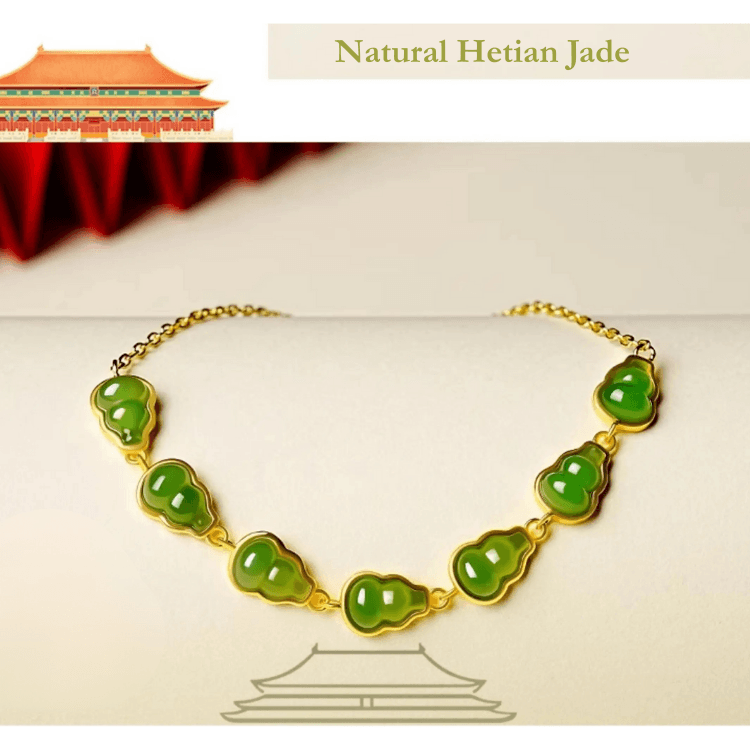
The Green Hetian Jade Talisman Hulu Bracelet: A Daily Reminder
Traditional culture has long paired natural materials with auspicious symbols as everyday reminders. RUYI Jewelry continues that practice through a contemporary, minimalist design language.
To faithfully articulate the cultural integrity of the Wood element, we selected natural, untreated Green Hetian Jade. Distant from the aggressive sparkle of Western-cut gemstones, this jade possesses a deep, velvety inner glow—a serene green reminiscent of a forest quietly gathering strength in early spring. It remains entirely restrained, elegant, and composed.
At the center of the bracelet sits a minimalist Hulu (gourd) motif, hand-carved in 925 silver—a nod to authentic Chinese Aesthetic Jewelry. In Eastern tradition, people regard the gourd as a symbol that gathers and neutralizes unaligned energies. Furthermore, artisans traditionally associate wearing this bracelet with steady, sustained growth. Thus, it functions as a quiet, daily companion: a physical anchor reminding the wearer that growth hasn’t stopped, even when things feel stagnant.
Why RUYI Jewelry
We believe luxury should be meaningful. Authenticity. Craftsmanship. Intentional design. These three principles guide every piece in the Five Elements Collection.
Authenticity – All gemstones are natural. No glass, resin, or imitation.
Craftsmanship – Each gemstone is carefully selected, cut, and set by experienced artisans.
Intentional Design – Colors, shapes, and metal pairings honor traditional symbolism while embracing contemporary minimalist aesthetics.
Frequently Asked Questions
What is the Wood element’s primary difference between Jia and Yi? Neither is better or worse—they represent two different states and needs. Traditionally, most people carry both qualities; which one is more relevant simply shifts depending on the season of life you’re in.
Does calling Jia Wood “dead wood” mean something negative? This is classical terminology, referring to raw material that requires external shaping to reach its potential—not a negative judgment. Traditionally, the material that most needs refining often possesses the greatest potential.
How do I care for Green Hetian Jade? Use a soft cloth with a mild cleanser. Avoid ultrasonic cleaners, and keep the stone away from prolonged contact with harsh chemicals.
Are the “modern interpretations” in this article part of the original classical texts? No. Anywhere this article extends a classical passage into a modern, everyday perspective, we’ve marked it clearly as RUYI’s own reading—offered for reflection, not presented as what the original text itself was discussing.
Wood Doesn’t Need to Rush Toward the Sky
Whether you feel closer to the raw, unshaped timber waiting to be worked, or the vine reaching for nourishment, Wood offers the same reminder either way: growth has its own pace. It doesn’t need to be forced, and a season of stillness isn’t something to panic over.
Discover your element today.
[Shop the Green Hetian Jade Talisman Hulu Bracelet →]
Written by Hao, founder of RUYI Jewelry. Hao holds a master’s degree in biology and approaches Chinese philosophy with both cultural curiosity and scientific grounding.