In contemporary wellness conversations, people frequently reduce the Fire element meaning to a literal, volatile image—wildfires, heat, or destructive physical flames. Yet, in the profound architecture of classical Chinese philosophy, Fire was never a chaotic hazard. Instead, it embodies the midsummer peak of life itself: the maximum expression of visibility, conscious awareness, and transformative passion. Under closer inspection, it represents the innate drive to cultivate clarity, the unyielding warmth of connection, and the radiant confidence of self-expression.
Have you ever felt cold and numb deep down in life, unable to grasp your inner intuition and inspiration, drifting aimlessly through each day? You can clearly sense your old passion fading away, yet you are utterly helpless to change it. Within the traditional Five Elements framework, scholars often describe this state as a depletion or misalignment of Fire energy in the mind. In light of this, understanding Fire means learning how to shine brightly without burning out, and how to illuminate our inner path through darkness rather than fleeing from it.
Bing Fire and Ding Fire: Two Faces of the Same Element
Classical Chinese fate philosophy divides the Fire element into two distinct temperaments through the Heavenly Stems system—one cosmic and brilliant, one intimate and adaptable. Together, they offer two complete, equally valid models of radiance.
Bing Fire — The Radiance of the Midday Sun
Bing Fire represents the purely Yang, vigorous expression of the Fire element. The classical text San Ming Tong Hui (三命通會) records:
“丙火麗乎中天,普照六合;在天為日為電,在地為爐為冶,謂之陽火。”
“Bing Fire hangs beautifully in the center of the sky, illuminating the universe; in heaven it is the sun and lightning, on earth it is the furnace and metallurgy—this is called Yang Fire.” — San Ming Tong Hui, Volume 2
On the other hand, the text continues with a profound paradox regarding its lifespan: Bing Fire is born in the east (the wood of Yin) and reaches its demise in the west (You). Traditionally, this description suggests that Bing Fire, like the sun, requires a seasonal cycle of emergence and setting rather than an eternal, blinding glare. As a result, its true power relies on timing and alignment, for even the sun dims when heavy clouds or excessive soil obscure its brilliance. It remains a strength that thrives on intentional presence and generous boundaries.
Ding Fire — The Spark of the Evening Star
Ding Fire is Fire’s Yin expression. San Ming Tong Hui describes it this way:
“丁火繼丙之後,為萬物之精,文明之象;在天為列星,在地為燈火,謂之陰火。”
“Ding Fire follows after Bing, acting as the essence of all things and the symbol of civilization; in heaven it is the array of stars, on earth it is the lamp and candle—this is called Yin Fire.” — San Ming Tong Hui, Volume 2
In contrast, Ding Fire does not dominate the landscape. It waits for the world to grow quiet, for stars only shine their brightest when night falls, and a candle only reveals its guidance in the dark. Furthermore, ancient scholars noted that Ding Fire depends on living wood to sustain its delicate glow, much like oil feeding a wick. Ultimately, what it needs isn’t grand scale—it requires consistency, careful shelter, and continuous internal nourishment.
In popular usage, people often simplify these two images to “Bing Fire as the sun, Ding Fire as the candle.” Although that version is more widely known, the original San Ming Tong Hui characterization remains far more precise: Bing Fire’s defining feature involves cosmic illumination , whereas Ding Fire’s defining feature centers on targeted guidance and civilized refinement.
From the Ditian Sui: Tempering and Transformation
The Ditian Sui (滴天髓), alongside San Ming Tong Hui, remains one of the canonical texts of Chinese fate philosophy. Its foundational wisdom teaches that raw Metal—the unrefined aspects of our boundaries and structures—cannot achieve its true potential without the precise heat of Fire.
We read this as a reflection on emotional tempering. For instance, when we face rigid habits or unyielding fears, gentle comfort alone cannot change them. For this reason, a certain degree of inner warmth—represented by the focused heat of Ding Fire—is required to melt away old armor and reshape our lives.
Meanwhile, if that inner fire becomes too aggressive or scattered, it risks burning through our foundations entirely.
Fire and the Mind: A Traditional Association
Traditional Chinese medical theory also maps the Five Elements onto the body’s internal landscape. Within this ancient framework, the Heart is traditionally associated with Fire, serving as the residence of Shen—our spirit, consciousness, and emotional warmth.
Importantly, this is a description from traditional philosophy, not a modern clinical diagnosis. When Fire energy is considered balanced, traditions link it to joy, emotional clarity, and a natural charisma. Conversely, when it is considered blocked or excessive, historical texts sometimes associate it with restlessness, anxiety, or a scattered mind.
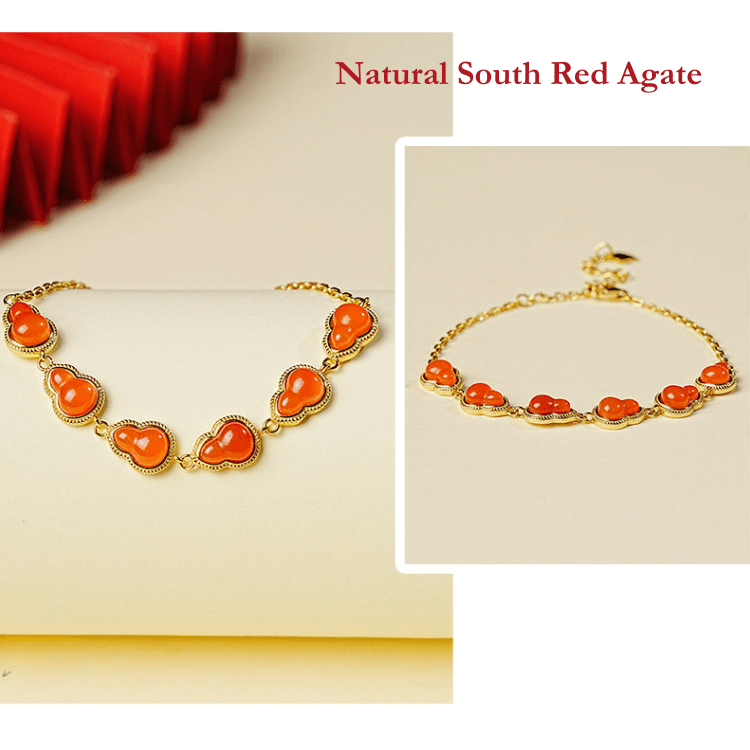
The South Red Agate/Amethyst Talisman Hulu Bracelet: A Daily Reminder
Traditional culture has long paired natural materials with auspicious symbols as everyday reminders. RUYI Jewelry continues that practice through a contemporary, minimalist design language.
To faithfully articulate the cultural integrity of the Fire element, we selected natural, untreated South Red Agate/Amethyst. Distant from the aggressive, superficial sparkle of synthetic glass, this stone possesses a deep, syrupy inner warmth—a rich carnelian red reminiscent of a steady hearth glowing quietly through a midsummer night. It remains entirely restrained, elegant, and composed.
At the center of the bracelet sits a minimalist Hulu (gourd) motif, hand-carved in 925 silver—a nod to authentic Chinese Aesthetic Jewelry. In Eastern tradition, people regard the gourd as a symbol that gathers and neutralizes unaligned energies. Furthermore, artisans traditionally associate wearing this bracelet with steady, radiant vitality. Thus, it functions as a quiet, daily companion: a physical anchor reminding the wearer that their inner spark hasn’t gone out, even when the soul feels cold.
Why RUYI Jewelry
We believe luxury should be meaningful. Authenticity. Craftsmanship. Intentional design. These three principles guide every piece in the Five Elements Collection.
Authenticity – All gemstones are natural. No glass, resin, or imitation.
Craftsmanship – Each gemstone is carefully selected, cut, and set by experienced artisans.
Intentional Design – Colors, shapes, and metal pairings honor traditional symbolism while embracing contemporary minimalist aesthetics.
Frequently Asked Questions
What is the Fire element’s primary difference between Bing and Ding? Neither is better or worse—they represent two different states and needs. Traditionally, most people carry both qualities; which one is more relevant simply shifts depending on whether you need to broadcast your energy outward like the sun, or focus inward like a star.
Does Fire always mean passion and intensity? This is a modern simplification. In classical terminology, Fire is equally about clarity, observation, and civilization. Traditionally, the most sustainable fire is not the one that rages wildly, but the one that provides steady warmth over time.
How do I care for South Red Agate/Amethyst? Use a soft cloth with a mild cleanser. Avoid prolonged exposure to extreme direct heat, and keep the stone away from harsh industrial chemicals.
Are the “modern interpretations” in this article part of the original classical texts? No. Anywhere this article extends a classical passage into a modern, everyday perspective, we’ve marked it clearly as RUYI’s own reading—offered for reflection, not presented as what the original text itself was discussing.
Fire Doesn’t Need to Burn the World Down
Whether you feel closer to the midday sun illuminating everything in its path, or the quiet star waiting for its moment to guide the way, Fire offers the same reminder either way: radiance has its own rhythm. It doesn’t need to be forced into exhaustion, and a season of shadows is simply the canvas upon which your light becomes visible.
Discover your element today.
[Shop the South Red Agate/Amethyst Talisman Hulu Bracelet →]
Written by Hao, founder of RUYI Jewelry. Hao holds a master’s degree in biology and approaches Chinese philosophy with both cultural curiosity and scientific grounding.