
How to Tell If a Gemstone Is Real (And Avoid Getting Scammed by Fakes)
By Hao, Founder of RUYI Jewelry Last updated: August 2026
A note from the author: I’m Hao, founder of RUYI Jewelry, with a background in biology rather than certified gemology. What follows are practical checks any buyer can try at home, along with what we actually do during our own sourcing and quality checks — not textbook theory borrowed from somewhere else.
Why Gemstone Authenticity Matters
The price gap between a natural gemstone and a synthetic or imitation one can be enormous. The market has no shortage of ways to blur that line: passing off lesser stones as premium ones, dyeing, resin filling, or simply mislabeling.
We believe in informed buying. This guide won’t turn you into a certified gemologist, but it will give you a real starting point.
By the end, you’ll know how to:
- Spot the basic signs of a natural versus a synthetic or imitation stone
- Recognize the specific tells for each gemstone RUYI works with
- Read a lab certificate well enough to avoid being fooled by one
The Basic Logic Behind Gemstone Identification
What Actually Counts as “Real”?
Gemstones generally fall into a few categories: natural, synthetic (lab-grown), and imitation.
- Natural gemstones form entirely through geological processes and are only cut and polished afterward.
- Synthetic gemstones are grown in a lab with the same chemical makeup as their natural counterparts, but at a fraction of the price.
- Imitations use cheap materials — glass, plastic, or lower-grade stones — to mimic the look of something more valuable.
Here’s the key distinction: a synthetic gemstone isn’t inherently a scam. Selling one at natural-gemstone prices is.
A Layered Approach Works Best
Real gemstone identification moves from simple to complex, and from the outside in:
| Level | Method | Tools Needed | What It Reveals |
|---|---|---|---|
| First | Visual inspection | Your eyes, good lighting | Color distribution, luster, transparency |
| Second | Magnified inspection | 10x loupe | Inclusions, facet edges, growth patterns |
| Third | Simple physical tests | Hardness, weight, temperature | Density, hardness, thermal conductivity |
| Fourth | Lab-grade testing | Refractometer, microscope, spectrometer | Refractive index, internal structure, spectral signature |
One rule holds throughout: no single method can confirm authenticity on its own. Cross-checking multiple signs is what actually works.
Visual and Magnified Inspection: Your First Line of Defense
Inclusions Are a Gemstone’s Fingerprint
Natural gemstones form over long stretches of geological time, and that process leaves behind distinctive internal traces.
- Natural stones typically show needle-like, thread-like, or wispy inclusions, with color that shifts unevenly across the stone.
- Synthetic stones more often show bubbles or curved growth lines, with flat, uniform color.
- Imitations may show bubbles, dye residue, or a texture that looks a little too flawless.
Here’s the counterintuitive part: a “perfect” gemstone is the one worth questioning. Almost every natural stone carries some kind of inclusion — and that imperfection is actually its best proof of authenticity.
Color and Luster
Natural gemstones tend to show depth and unevenness in color, with shifts visible from different angles. Their luster looks soft and organic. Imitations often look flat or unnaturally shiny. Dyed stones may show vivid but lifeless color, with pigment visibly pooled along fractures under magnification.
Facet Edges and Cut
Natural stones usually have sharp, clean facet edges. Synthetic or imitation material can show edges that are rounded or slightly rough by comparison.
Simple Physical Tests You Can Try at Home
Hardness Test
Natural gemstones tend to be harder than their imitations. Here’s how RUYI’s core materials stack up:
| Gemstone | Mohs Hardness | Can It Scratch Glass? |
|---|---|---|
| Tourmaline | 7.5 | Yes |
| Hetian Jade | 6–6.5 | Yes |
| Quartz (Citrine/Amethyst) | 7 | Yes |
| Jadeite | 6.5–7 | Yes |
| South Red Agate | 6.5–7 | Yes |
This method only applies to loose stones, not finished, mounted jewelry — attempting it on a set piece risks damaging both the stone and the setting. If you’re testing a loose stone, gently drag an inconspicuous edge of it across glass. If the glass scratches and the stone doesn’t, that’s a good sign.
A word of caution: this test carries some risk of damage. For most people, the non-destructive observation methods below are a safer starting point.
The Weight Test
Natural gemstones tend to be denser than glass or plastic imitations. A real stone feels noticeably heavier in your hand; an imitation often feels surprisingly light.
The Temperature Test
Natural gemstones conduct heat quickly, so they feel distinctly cool the moment you pick them up, and only gradually warm to match your body temperature. Glass or plastic imitations tend to feel lukewarm from the start, without that initial chill.
Double Refraction Test (For Quartz-Family Stones)
Quartz is optically anisotropic, meaning light behaves differently depending on direction as it passes through — a property known as double refraction. Place the stone over text or a line drawing and look through it: a natural quartz stone will show a faint doubling of the image as you rotate it, while glass, being optically uniform, only ever shows a single image.
One caveat: quartz has a relatively low degree of double refraction, so this effect can be subtle and takes a bit of practice to see clearly. Tourmaline, which has a stronger double refraction, tends to show this effect much more obviously.
A Closer Look at RUYI’s Materials
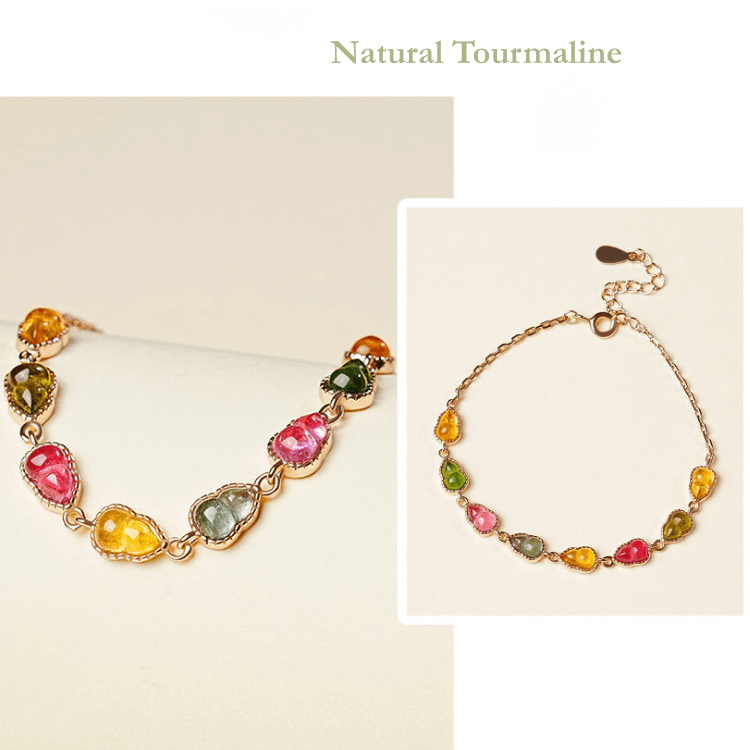
Tourmaline (Tourmaline Talisman Hulu Bracelet)
Natural tourmaline is rich with irregular, one-of-a-kind inclusions — fingerprint- or feather-shaped fluid inclusions, hair-thin parallel tube inclusions, healed fractures with a cone- or saw-tooth-like appearance, and occasional solid mineral inclusions such as mica or garnet.
What’s genuinely rare is lab-grown tourmaline itself. As the Gemological Institute of America noted back in 2005, hydrothermally grown tourmaline remained purely experimental at that point. A later clarification from gemologist Bear Williams in 2009 confirmed that earlier reports of synthetic tourmaline reaching the market had actually stemmed from a misidentification — commercial synthesis still isn’t a meaningful factor in the gemstone trade today. What you’re far more likely to encounter is glass or synthetic spinel sold under a tourmaline-adjacent name, or dyed quartz passed off as tourmaline. These imitations tend to show smooth, curved growth lines or perfectly round bubbles — a sharp contrast to natural tourmaline’s irregular inclusions.
The first time you look closely at a natural tourmaline’s interior, your instinct might be “wait, isn’t this a flaw?” That’s the effect of imitation stones training your eye to expect artificial perfection. Spend more time with natural stones, and the pattern flips: the real ones grow more interesting the longer you look, while the fakes start to feel hollow.
What’s actually worth watching for with tourmaline is heat treatment, irradiation, or resin filling used to enhance color — not synthetic material, which is barely a real risk in this case.
[Shop the Tourmaline Bracelet →]
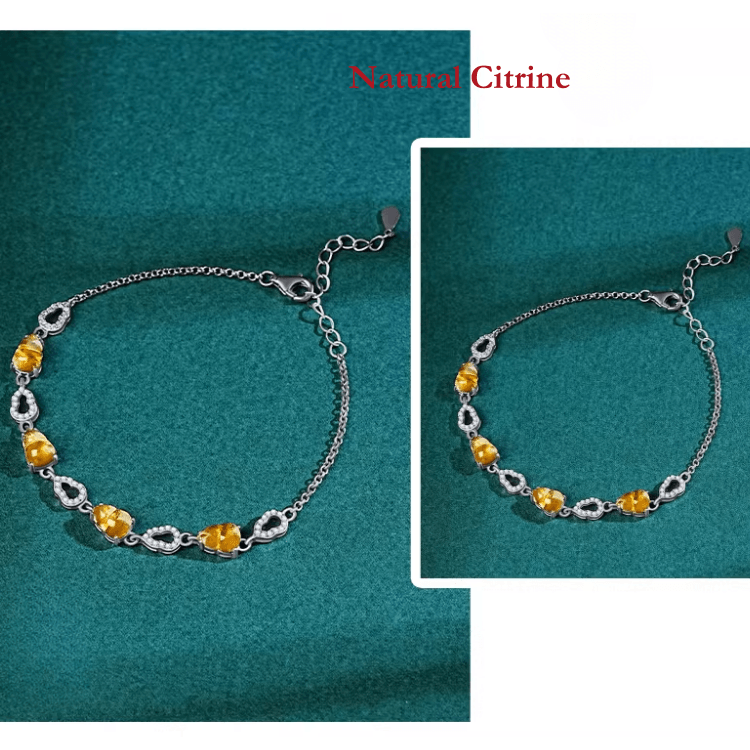
Citrine (Citrine Talisman Hulu Bracelet)
Natural citrine’s color pattern varies stone to stone — some show fairly even color, others show subtle, irregular shifts in tone. What matters more than “even versus uneven” is the shape of any banding you see. Inside, natural stones often carry cotton-like wisps, ice-crack patterns, or fluid inclusions.
The clearest red flag is regular, parallel color banding that lines up with a flat seed-plate surface — a telltale sign of hydrothermally grown synthetic quartz. This kind of neat, repeating pattern essentially never occurs in natural citrine. Heat-treated amethyst sold as citrine tends to look suspiciously uniform too, lacking any natural color variation at all.
Quick check: look for unnaturally clean, parallel banding — that’s the flag to watch for, not a lack of color variation on its own. Viewing the stone against text also reveals the same double-refraction effect described above.
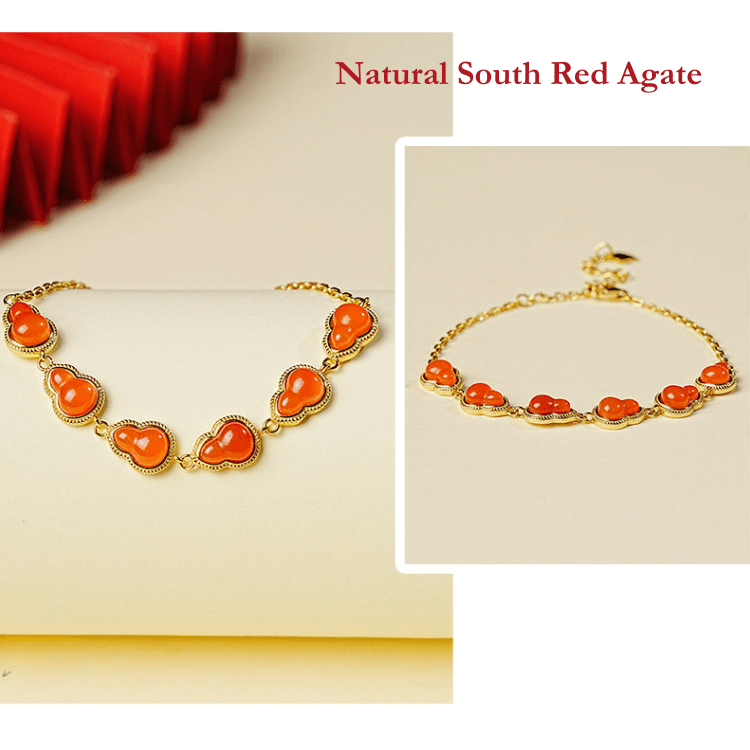
South Red Agate (South Red Agate Talisman Hulu Bracelet)
Natural South Red Agate has a rich, waxy translucence, with sharp, well-defined patterning and edges that let light through when lit from behind with a strong flashlight.
Watch for heat-treated agate, which looks dull and flat with color sitting on the surface rather than running through the stone, and dyed agate, which shows a web-like dye pattern along fractures under magnification. Red jasper — a common substitute — is opaque, stony-looking, and lacks any translucence.
Quick check: shine a strong flashlight from the side. Natural South Red Agate will let some light through at the edges; red jasper won’t let any through at all.
[Shop the South Red Agate Bracelet →]
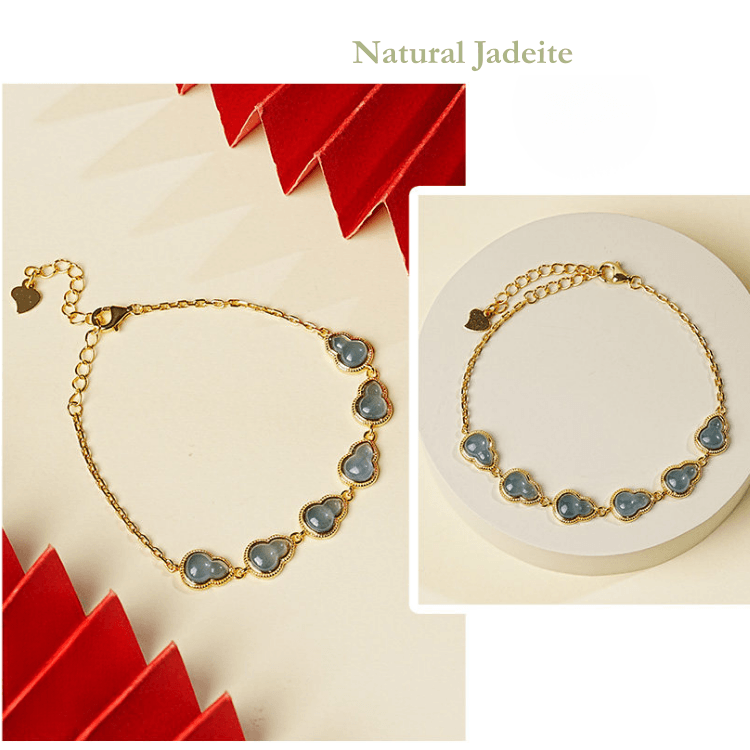
Jadeite (Blue Toned Jadeite Talisman Hulu Bracelet)
Untreated jadeite (“A-grade”) has a soft, glassy luster, natural depth of color, and a clear, bright sound when tapped.
Be aware of B-grade jadeite (acid-treated and resin-injected, giving it a cloudy, resinous look) and C-grade jadeite (dyed, with color that looks vivid but flat).
Professional appraisers sometimes use the tap-sound test — a clear ring for A-grade, a dull thud for B-grade — but this is highly subjective for untrained ears and carries a real risk of chipping the stone. A safer approach is simply examining the luster and internal clarity closely: B-grade jadeite tends to look cloudy and lacks that natural glassy shine.
[Shop the Blue Toned Jadeite Bracelet →]
Amethyst (Amethyst Talisman Hulu Bracelet)
Natural amethyst shows graduated color, unevenly distributed from pale to deep purple, along with cotton-like inclusions, ice-crack patterns, or other mineral inclusions — and importantly, no bubbles.
Synthetic amethyst tends to look suspiciously uniform and flawless, occasionally with small bubbles. Glass imitations may show bubbles too, and won’t have that cool-to-the-touch quality natural stone has.
Quick check: look for color-band variation, and search for natural inclusions under magnification — a stone that looks too perfect is the one to question.

[Shop the Amethyst Bracelet →]
For our take on Green Hetian Jade and White Hetian Jade specifically, see our companion guide, Natural Jade vs. Dyed Jade: What to Look For, where we go into much more depth.
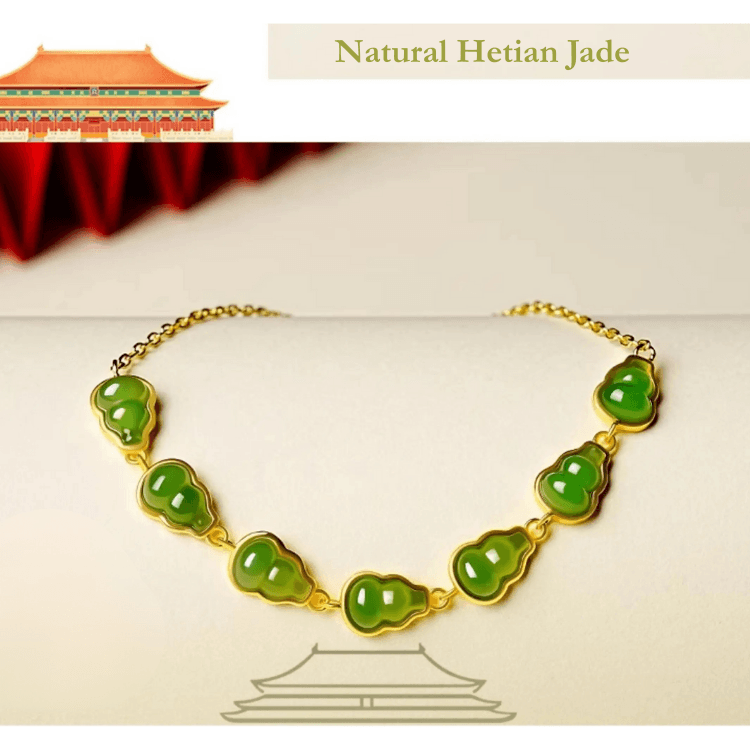
[Explore Green Hetian Jade Bracelets →]
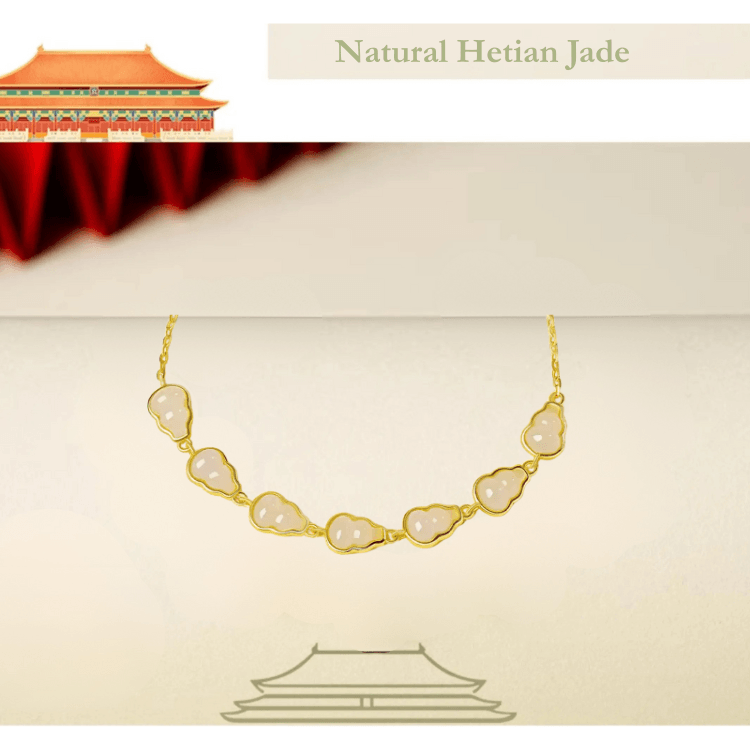
[Explore White Hetian Jade Bracelets →]
Lab Testing and Certificates
When Do You Actually Need Professional Testing?
Reach for professional testing when simple checks leave you uncertain, when you’re buying a higher-value stone (and ideally, ask for a certificate before you buy), or whenever you have lingering doubts about a piece you already own.
Reputable Testing Institutions
Internationally recognized labs include:
- GIA (Gemological Institute of America) — the global standard for diamonds and colored gemstones
- IGI (International Gemological Institute)
- HRD (Hoge Raad voor Diamant, Belgium)
- In China: NGTC (National Gemstone Testing Center)
How to Read a Certificate
A few things worth checking: the certificate number (verifiable on the issuing lab’s own website); recognized accreditation marks; standardized gemstone naming; explicit labeling of “natural” status; and any noted treatments (a certificate reading “jadeite (treated)” signals B- or C-grade material).
Verifying a Certificate in Practice
Every GIA-certified stone carries a unique report number that you can verify directly on GIA’s website. One caution: fraudulent sellers sometimes reuse legitimate certificate numbers for different stones, so it’s worth comparing the certificate details against the physical stone itself — including any laser inscription — in person.
Common Traps and How to Avoid Them
Five Common Tricks to Watch For
| Trick | How It Works | How to Spot It |
|---|---|---|
| Dyeing | Dye seeps into fractures to alter color | Color pooled along cracks, unnaturally vivid tone |
| Resin filling | Resin fills fractures to boost clarity | Web-like surface texture, cloudy luster |
| Synthetic passed off as natural | Lab-grown stone sold as natural | Suspiciously flawless, no inclusions |
| Cheap stone passed off as premium | Lower-value material mislabeled | Price doesn’t match the quality |
| Vague or invented naming | Non-standard names used to confuse buyers | Ask sellers to use standardized gemstone names |
A Few Ground Rules for Buyers
Be wary of prices that look too good to be true. Don’t treat origin or provenance alone as proof of authenticity. Ask for a certificate from a recognized lab, and learn to actually read it — checking the report number, accreditation marks, and stone name. Above all, buy from sellers with an established reputation.
Why RUYI Jewelry
Authenticity. Craftsmanship. Intentional design. These are the three standards we hold every piece to before it reaches you.
We’d rather be upfront about what we can promise, and what we can’t — yet.
What we can tell you: we work with a small number of long-term suppliers, not a rotating cast of unverified wholesalers. Our sourcing standard is explicit — natural, untreated gemstones only. If something doesn’t match its description, our return policy has you covered.
What we check before every piece ships (this is about craftsmanship, not gemstone authenticity — the two are separate things): every piece goes through inspection before it leaves us. We look at three things in particular. First, the setting — is the main stone and any accent stones secure, do the prongs sit flush, is the stress on the mount reasonable? Second, the finish — is the surface evenly polished, with no rough edges, leftover wax, or dead spots? Third, overall proportion — symmetry, thickness, and whether the piece will actually sit comfortably when worn. These details shape how a piece feels day to day, and we’d rather catch a problem before it ships than after it reaches you.
What we can’t yet promise: we don’t currently issue a third-party gemstone certificate with every piece. If you’re purchasing a higher-value stone, or want absolute material certainty, we’d point you back to the lab-testing section above.
Frequently Asked Questions
How do I know if a gemstone is real? No single method guarantees a definitive answer, but combining inclusion inspection, color and luster checks, and a couple of simple physical tests will get you most of the way there.
How can you tell if a gem is real at home? The weight test, the temperature test, and inspecting inclusions under a loupe are all things you can do without any special equipment.
How do you tell if a gem is real with a flashlight? Shine a strong light from the side and watch how it travels through the stone. With South Red Agate, for instance, a natural stone lets light through at the edges, while a red jasper imitation blocks it completely.
How do you spot a fake gem? Be suspicious of anything that looks “too perfect” — unnaturally even color, no visible inclusions, a flat or lifeless shine. Those are classic signs of synthetic or imitation material.
How do you identify a real gemstone? Start with a visual check, move to a loupe and simple physical tests, and if you’re still unsure — especially for a higher-value piece — a certificate from a recognized lab is the next step.
Does RUYI Jewelry sell only natural gemstones? Yes — our sourcing standard is explicit about that. What we don’t yet offer is a third-party certificate with every piece; see the “Why RUYI Jewelry” section above for exactly where that stands today.
Should I avoid synthetic gemstones entirely? Not necessarily. A synthetic gemstone isn’t a scam on its own — the problem is only when it’s sold at natural-gemstone prices without disclosure. Many people choose synthetics deliberately for the lower cost.
Final Thoughts
Gemstone identification works from the outside in, moving from simple checks to more advanced ones. No single method settles the question on its own. And counterintuitively, the “flawless” stone is the one that deserves the most scrutiny — a natural gemstone’s imperfections are the clearest proof of what it actually is.
Real beauty was never afraid of a closer look.
[Shop the Talisman Collection →]
Read more
[Natural Jade vs. Dyed Jade: What to Look For→]
[How to Choose Real Gemstone Beads→]
[Gemstone Jewelry Buying Guide: How to Choose the Right Piece→]